In the increasingly crowded race to build a convincing humanoid robot, simply walking without falling over is no longer enough to turn heads. Chinese EV maker XPeng knows this, and at its 2025 AI Day, it pulled the covers off its next-generation “IRON” humanoid, promptly labeling it the “most anthropomorphic” robot yet. While the claim is bold, the hardware and software stack behind it suggests XPeng is treating this not as a science project, but as the next logical step in its evolution into a “Physical AI” company.
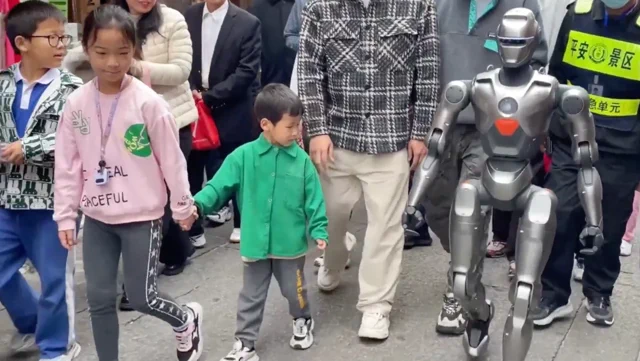
During the “Emergence” themed event, CEO He Xiaopeng noted that during rehearsals, some colleagues wondered if a real person was inside the robot’s shell. Looking at its unnervingly smooth gait, it’s an easy mistake to make. This isn’t just about looks; XPeng is betting that a more human-like form and function is the key to unlocking the data needed for robots to safely and effectively navigate a world built for, well, us. The IRON robot isn’t just a machine; it’s the physical embodiment of the AI powering XPeng’s entire ecosystem, from cars to the sky.
Bionic Bones and a Solid-State Heart
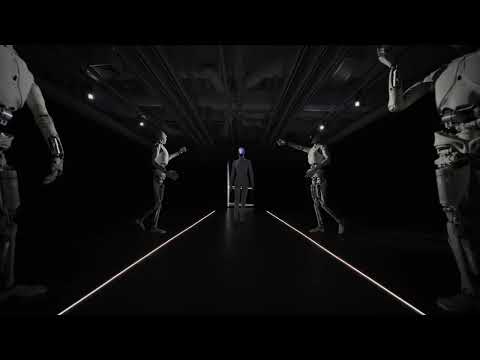
XPeng’s claim to be the “most human-like” isn’t just marketing fluff; it’s baked into the hardware. The IRON robot features a “bionic bone-muscle-skin” structure designed to mimic human biomechanics with an unprecedented level of detail.

Key to this is a flexible, human-like spine that allows the robot to bend and twist with a natural range of motion. This is paired with synthetic “bionic muscles” and a full-coverage soft skin embedded with touch sensors, which XPeng says makes interaction “warmer and more intimate.” The hands alone are a significant engineering feat, with each one possessing 22 degrees of freedom, enabling fine motor control for delicate tasks.

Perhaps the most significant hardware innovation is under the skin. XPeng announced that IRON is the first humanoid robot in the industry to use an all-solid-state battery. CEO He Xiaopeng defended using this cutting-edge tech in a robot instead of a car, arguing that the stringent safety requirements for a machine operating in close proximity to humans in homes and offices make it the perfect application. Solid-state batteries offer higher energy density and are inherently safer than their liquid-electrolyte counterparts, eliminating the risk of flammable leakage or thermal runaway.
The Brains Behind the Emergence
A convincing body is useless without a powerful brain. Here, XPeng leverages the massive AI infrastructure it built for its autonomous vehicles. The robot is powered by three of XPeng’s self-developed Turing AI chips, delivering a formidable 2,250 TOPS of computing power.
This hardware runs a complex, multi-modal AI architecture that combines three large models:
- VLA (Vision-Language-Action): The second generation of XPeng’s core autonomous driving model, which has evolved to translate vision directly to action, bypassing language for faster, more reflexive responses.
- VLM (Vision-Language Model): Powers advanced, low-latency conversational abilities.
- VLT (Vision-Language-Task): A new model announced for the first time, described as the “core engine” for the robot’s autonomous decision-making and task execution in the physical world.
This unified AI stack, trained on a cloud cluster of over 30,000 GPUs, allows IRON to see, move, and interact in real-time. It’s a clear strategy of cross-platform synergy, where advancements in automotive AI directly accelerate robotics development.

A Pragmatic Path to Market
While competitors are showcasing robots doing backflips and factory work, XPeng laid out a surprisingly pragmatic and cautious commercialization plan. After trials, the company concluded that deploying robots for industrial tasks like tightening screws is currently not cost-effective due to the high cost and wear on complex components like dexterous hands. Similarly, they believe the technology is not yet mature enough to guarantee safety for general-purpose household chores.
Instead, IRON will first be deployed in structured commercial settings as:
- Tour guides
- Shopping assistants
- Receptionists
The company plans to begin mass production preparations in April of next year, with the goal of achieving mass production by the end of 2026. They will also release an SDK to encourage global developers to build an application ecosystem around the robot.
More Than Just Robots
The IRON humanoid was the star, but XPeng’s AI Day underscored a much broader ambition. The underlying VLA 2.0 model is not just for robots; it’s the foundation for the company’s entire next generation of products. This includes a major push into Level 4 autonomous driving with upcoming “Robo” variants of their cars and a fleet of three RoboTaxi models set to begin trials in 2026.
In a massive vote of confidence, Volkswagen was announced as the first strategic partner for the VLA 2.0 system. The German auto giant will also use XPeng’s Turing AI chips in its vehicles, a significant milestone for the Chinese firm’s in-house hardware efforts. This deep collaboration validates XPeng’s technology on a global scale and provides a powerful new revenue stream.
By building a unified AI platform that powers cars, robotaxis, and humanoids, XPeng is making a calculated bet that the future of mobility and automation is interconnected. The IRON robot is more than just a flashy demo; it’s a statement of intent from a company that sees itself not just as a carmaker, but as a future architect of our AI-driven physical world.